Access to the full, detailed list of companies is reserved for members of nucleareurope. To explore membership benefits and join the association, visit our Join us! page.
Company
Areas of activity
Country
France
PYROCONTROLE
PYROCONTROLE
Civil & Structural Engineering, Electrical & I&C Systems, Engineering and intellectual services, IT & Digital Services, Mechanical Components & Manufacturing, Project Development & Project Management
France
PYROCONTROLE
Country:France
France
PYTHAGORE
PYTHAGORE
IT & Digital Services
France
PYTHAGORE
Country:France
France
Q2SER
Q2SER
Civil & Structural Engineering, Engineering and intellectual services, IT & Digital Services, Project Development & Project Management, Training & Employment
France
Q2SER
Country:France
United Kingdom
Q5 Partners
Q5 Partners
Other
United Kingdom
Q5 Partners
Country:United Kingdom
France
QUADRICA
QUADRICA
Civil & Structural Engineering, Engineering and intellectual services, IT & Digital Services, Security & Safety, Testing & Monitoring
France
QUADRICA
Country:France
France
Qualianor Certification
Civil & Structural Engineering, Engineering and intellectual services, IT & Digital Services, Security & Safety, Testing & Monitoring
France
Qualianor Certification
Country:France
Bulgaria
Quantum Engineering Ltd.
Country of operationsBulgaria, Czech republic, Hungary, Armenia
Quantum Engineering Ltd.
Electrical & I&C Systems, Engineering and intellectual services, Project Development & Project Management
Uranium is found in multiple areas of the globe, including Europe. For now, uranium is mainly imported from a diverse range of partners, but interest for uranium mining in Europe is growing.
Crucially, nuclear requires only very small quantities of uranium to generate large amounts of energy, giving Europe a strategic advantage: even modest stocks can support decades of reliable, net zero generation.
Beyond raw uranium supply, Europe benefits from well-established capabilities across the entire nuclear fuel cycle. This includes conversion, enrichment and, in some countries, reprocessing of used fuel. These integrated activities strengthen resilience, reduce external dependencies, and ensure a secure and flexible supply of nuclear fuel.
The diversity of uranium resources, combined with Europe’s industrial expertise across the fuel cycle, makes nuclear a key pillar of long-term energy security and reduced exposure to volatile fossil fuel markets.
Nuclear reactors do not all produce electricity. Many reactors across Europe are designed specifically for research purposes. These research reactors are used in fields science plays a vital role in advancing scientific discoveries, including for the development of nuclear medicine.
Nuclear-supported research strengthens Europe’s technological sovereignty, attracts top talent, and anchors high-value academic ecosystems that keep Europe at the forefront of scientific discovery and clean-energy innovation.
Nuclear power plays a critical role in securing reliable, large-scale, net zero energy for Europe’s cities, providing the continuous electricity and heat (district heating) that dense urban centres need to operate while meeting climate objectives.
Its ability to deliver stable, round-the-clock power helps strengthen energy security, reduce dependence on imported fuels, and protect households and businesses from price volatility across the European Union.
As cities face growing demand from electrified transport, data centres, and building decarbonisation, nuclear offers high predictability, strong output from a compact footprint, and long asset lifetimes, all essential in space-constrained urban environments. Beyond electricity, nuclear can also underpin district heating, hydrogen production, and desalination, reinforce urban resilience and competitiveness while accelerating the transition to climate-neutral European cities.
Nuclear power is an important pillar for rural communities across Europe, providing reliable, net zero electricity that supports local economies beyond major cities.
Nuclear plants are often located in less densely populated areas, where they create skilled long-term jobs, sustain local supply chains, and generate stable revenues for public services. By delivering constant power, nuclear helps rural industries and agri-food producers remain competitive while cutting emissions, strengthening energy security and supporting long-term regional resilience.
As a firm and dispatchable source of energy, nuclear provides reliable electricity 24/7. This supports the entire European energy system by ensuring a stable foundation.
In addition to delivering clean power, nuclear offers both flexibility and so-called inertia, a feature that helps maintain grid frequency and prevent sudden fluctuations.
Together, these characteristics improve grid stability and facilitate the integration of increasing amounts of variable renewable energy.
The nuclear sector can play a decisive role in supporting the decarbonisation of many European industries by supplying reliable, large-scale net zero electricity alongside continuous industrial heat, both essential for sectors such as steel, chemicals, cement and refining.
Nuclear power supports the electrification of energy-intensive processes and enables the production of clean hydrogen at scale, while reactors can also directly provide heat for applications such as steam generation, district heating and feedstock preparation, helping to replace fossil fuels where electrification alone is not sufficient.
By anchoring industrial clusters with stable, carbon-free energy, nuclear reduces exposure to volatile gas markets, strengthens industrial competitiveness, and supports the climate objectives of the European Union, making it a critical pillar of Europe’s pathway to net zero while safeguarding jobs and strategic manufacturing capacity.
Electrification will be vital to the decarbonisation of the transport industry. It will drive a significant increase in Europe’s electricity demand over the coming decades. According to Wood Mackenzie, Europe’s public Electric Vehicle charging infrastructure is projected to grow at a compound annual growth rate of 10.7% between 2025 and 2040, and EV charging is expected to account for around 9% of total electricity demand across the top nine European EV markets by 2040.
Meeting this additional demand requires large volumes of reliable, net-zero power available at all times, particularly to support overnight and off-peak charging. In this context, nuclear plays a critical role by providing continuous electricity with very low lifecycle emissions, helping to supply the growing EV load without increasing system emissions or reliance on imported fossil fuels.
Nuclear waste reprocessing is important for Europe because it allows valuable materials in spent fuel to be reused, reducing both the volume and long-term radiotoxicity of waste requiring final disposal.
By recycling uranium and plutonium into new fuel, reprocessing strengthens energy security, lowers reliance on newly mined uranium, and maximises the contribution of clean nuclear power to Europe’s climate goals.
It also supports a more efficient and manageable approach to long-term waste disposal while sustaining European industrial and technological leadership in the nuclear fuel cycle.
Maintaining Europe’s nuclear fuel manufacturing capacity in the continent is crucial to energy sovereignty. As uranium demand grows in Europe, it is essential that efforts to ramp up domestic enrichment capacity are supported.
Nuclear technologies play a critical role in modern medicine. Radioisotopes are widely used in diagnostic imaging, including PET and SPECT scans, enabling early detection of cancers, cardiovascular diseases and neurological disorders. In radiotherapy, precise radiation beams are used to treat tumours while preserving surrounding tissue, improving survival rates for millions of patients each year.
Nuclear technologies are also used in a range of other diagnostics tools. For example, in COVID-19 PCR tests, radioisotopes and irradiation techniques help sterilise equipment and support the production of key reagents, while nuclear-derived methods in molecular biology enable the precise detection of viral genetic material.
Electrolysis, which is one of the processes used to produce clean hydrogen, is most cost-efficient when running on a constant supply of electricity, making nuclear one of the best suited power sources for the process.
According to an analysis by Compass Lexecon, aiming for 150GW of installed nuclear capacity by 2050 could result in a reduction of around 33% of clean hydrogen imports, strengthening European energy sovereignty and reducing dependence on imported fuels.
Nuclear power is particularly well suited to desalination because it delivers large volumes of reliable, net zero energy and heat. Nuclear plants provide continuous electricity, enabling round-the-clock freshwater production with stable operating costs, while waste heat can be directly reused to improve the efficiency of thermal desalination systems.
This combination makes nuclear desalination both economically attractive and climate-aligned, offering a resilient solution for water-stressed regions seeking to decarbonise while strengthening energy and water security.
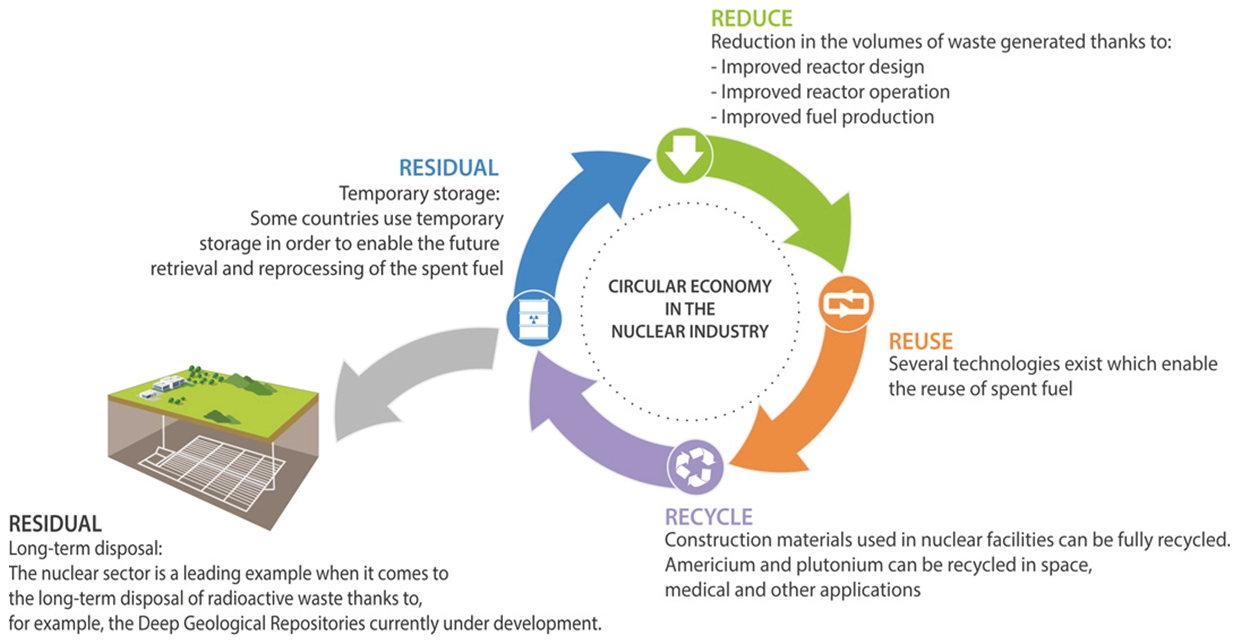
Several improvements have been implemented in the nuclear lifecycle, leading to a reduction in the volumes of waste generated
Much of the spent nuclear fuel remains a valuable resource for the nuclear industry and is therefore reused.
The industry implements well developed waste separation technologies which means that what might otherwise be considered as a waste can in fact be recycled in many different ways.
Of course, like other industries, a very small percentage of the waste generated does become residual waste, particularly high-level waste. But even here, the nuclear sector is a leading example when it comes to handling such waste.
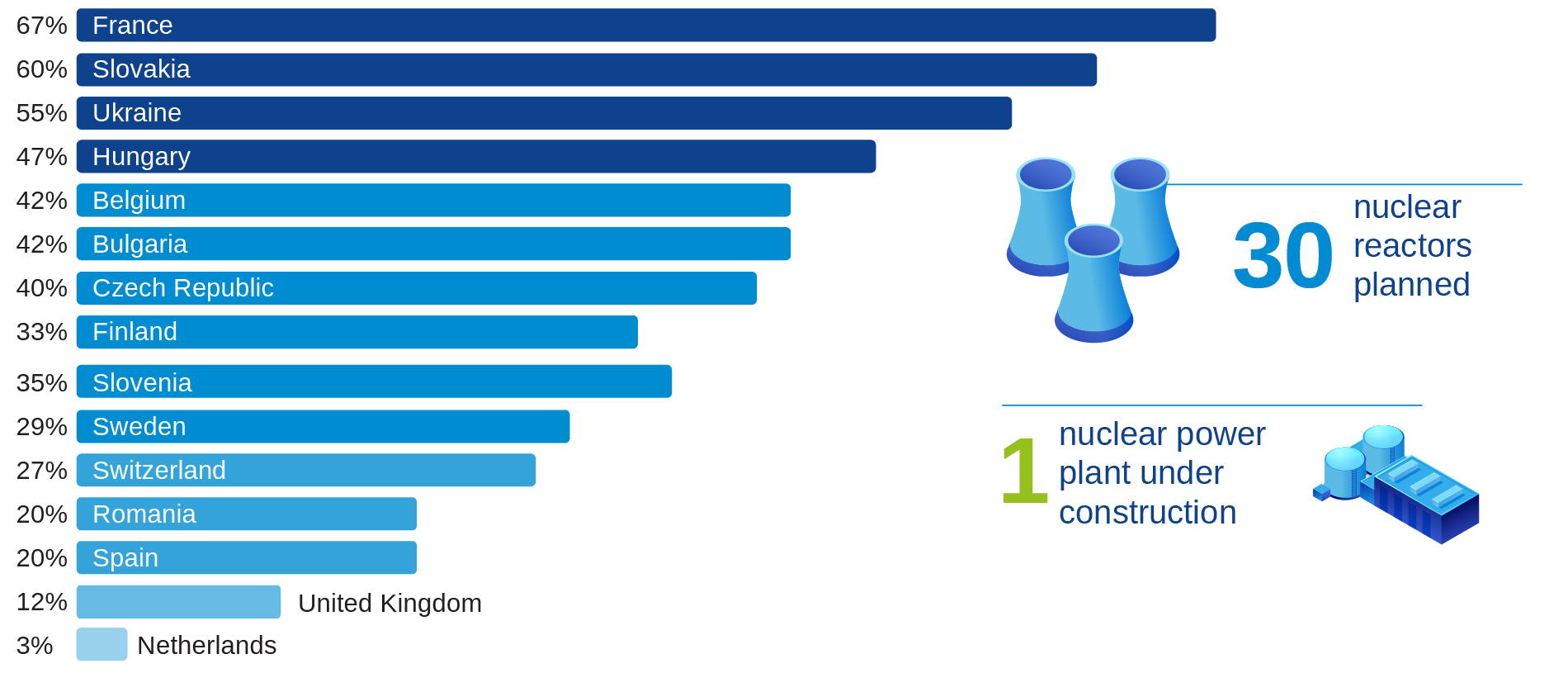
Today, nuclear energy remains one of Europe’s most strategic assets. It provides around one quarter of the EU’s electricity, delivering reliable, net-zero power that stabilises the grid and supports the integration of variable renewables.
Nuclear power plants are a major source of electricity in several Member States